Memory Boost Worksheets: Printable & Digital Recall Routines

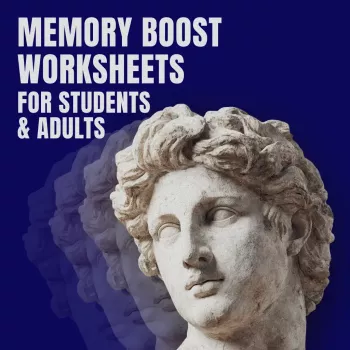
Memory Boost Worksheets for Students & Adults: Printable Exercises, Study Tools, and Recall Routines
Stronger memory is less about “having a good brain” and more about practicing the right skills consistently. This printable digital worksheet set is designed to turn proven memory habits—attention, encoding, retrieval practice, and review—into simple daily exercises for students, professionals, and lifelong learners who want better recall, faster studying, and clearer thinking.
The pages are built around what learning research consistently supports: spacing and self-testing beat rereading. If you want a deeper look at why, the Stanford Encyclopedia of Philosophy’s overview of the spacing effect and the American Psychological Association’s notes on retrieval practice explain the “why” behind the routines.
What These Memory Worksheets Help Train
Memory improves fastest when practice targets the specific bottleneck. These guided pages focus on the core skills that make recall dependable in school, at work, and in everyday learning.
- Attention control: reducing mental drift so information gets encoded the first time.
- Working memory: holding and manipulating details (numbers, steps, concepts) without losing track.
- Long-term retention: moving material from short-term exposure to durable memory traces.
- Retrieval strength: practicing recall so knowledge becomes easier to access under pressure.
- Study efficiency: replacing long rereads with structured prompts that reveal what’s actually known.
Who It’s For (Students, Adults, and Skill Builders)
The prompts work across subjects and skill domains because they train process, not just content. Use them for math, history, science, language learning, certification study, or any situation where you need reliable recall.
- Middle school, high school, and college learners preparing for quizzes, exams, and presentations.
- Adult learners in certification programs or professional training who need reliable recall.
- Busy professionals who want quick mental workouts that fit into short breaks.
- Anyone rebuilding study confidence after a long break from school or structured learning.
- People who prefer guided prompts over open-ended journaling or unstructured “brain games.”
How to Use the Worksheets for Better Study and Recall
The best results come from short, repeatable sessions that make recall slightly challenging. Keep it simple: learn, recall, check, and revisit later.
- Start with a 10–15 minute daily block: consistency beats occasional long sessions.
- Use a simple loop: learn → write a summary from memory → check → correct → repeat later.
- Keep difficulty “desirable”: slightly challenging recall builds stronger memory than easy review.
- Add spacing: revisit the same topic after 1 day, 3 days, 1 week, and 2 weeks.
- Finish with a quick self-test: short quizzes or prompts to measure progress objectively.
Simple weekly routine using printable or digital pages
| Day | Focus | Time | Worksheet-style prompt |
|---|---|---|---|
| Day 1 | Initial learning + first recall | 15–25 min | Read/learn, then write key points from memory; check and correct |
| Day 2 | Spaced recall | 10–15 min | Answer recall questions without notes; mark weak spots |
| Day 4 | Interleaving | 10–20 min | Mix two topics; compare/contrast; retrieve examples for each |
| Day 7 | Low-stakes test | 15–25 min | Timed quiz or “blank page” brain dump; review errors |
Memory Techniques You Can Practice Inside the Pages
Each worksheet prompt is a container for evidence-based techniques. The goal isn’t to “do more”—it’s to do the right reps.
- Active recall prompts: producing answers without looking first to strengthen retrieval pathways.
- Chunking: grouping details into meaningful units (steps, categories, patterns) to reduce load.
- Elaboration: adding “why” and “how” explanations to create more connections for recall.
- Dual coding: pairing brief visuals or simple diagrams with words for richer memory cues.
- Mnemonics: acronyms, acrostics, and narrative hooks for lists, sequences, and vocabulary.
For broader, practical guidance on supporting memory and thinking skills across adulthood, the National Institute on Aging shares helpful context here: Memory and thinking skills.
Printable vs. Digital: Choosing the Format That Sticks
The “best” format is the one you’ll repeat consistently. Many learners use both: print the core pages for focused work and keep a digital tracker for spaced-review dates.
Format comparison at a glance
| Format | Best for | Strength | Watch-out |
|---|---|---|---|
| Printable | Focused study sessions | Less distraction; handwriting benefits | Requires printing and a consistent storage spot |
| Digital | On-the-go practice | Reusable; easy to organize and search | More device distractions; needs a clear routine |
Measuring Progress Without Guessing
Recommended Downloads to Support Your Routine
If you want a structured set of guided prompts you can reuse across subjects, start here: Memory Boost Worksheets for Students & Adults | Printable Digital Download | Brain Training eBook, Memory Techniques, Study & Recall Tools. It’s designed to make daily recall practice straightforward—whether you print pages for a binder or complete them digitally.
If you also like checklists and structured prompts for everyday decisions (the same “reduce mental load” mindset), this companion-style download can fit well into a planning system: How to Pick Dining Chairs Checklist | Digital Download Guide for Choosing the Perfect Dining Room Chairs.
FAQ
How long does it take to see improvement in recall?
Small gains can show up within 1–2 weeks if you practice daily and actually retrieve from memory before checking notes. More reliable, “it comes to mind when I need it” recall often builds over 4–6 weeks when you combine spacing with self-testing.
Are these worksheets suitable for both students and working adults?
Yes. The prompts train universal memory skills (active recall, chunking, and review scheduling), so you can apply them to school subjects, certification material, presentations, and day-to-day learning.
Should the worksheets be printed, or can they be used on a tablet?
Either works. Printing supports distraction-free handwriting, while tablet use supports reuse, portability, and quick edits—choose the format that makes it easiest to practice consistently.















Leave a comment