Mecanum Robot Car with Arm: AI Pick-and-Place
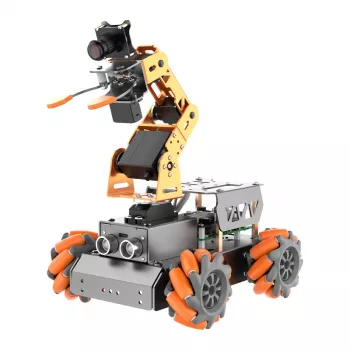
AI-Enhanced Smart Robot Car with Mecanum Wheels and Robotic Arm
A mobile robot that can glide in any direction and also grasp, lift, and place objects opens up a wide range of hands-on projects—from navigation challenges to sorting tasks and simple automation demos. The AI-Enhanced Smart Robot Car with Mecanum Wheels and Robotic Arm pairs mecanum wheels for smooth omnidirectional movement with a robotic arm for interactive manipulation, making it a versatile platform for experimenting with motion control, perception, and task workflows.
What Makes This Robot Car Different
Many beginner robot cars focus on basic forward/back driving. This platform stands out because it combines an agile mobile base with a manipulator, so you can practice both navigation and object interaction without building a separate arm rig.
- Mobile base + arm in one platform: Drive to a target and physically interact with it (pick, place, press, present).
- Mecanum drive for precision alignment: Strafe sideways, glide diagonally, and rotate in place to “dock” the arm where you need it.
- AI-enhanced project potential: Depending on the included board/software, you can explore assisted routines like tracking, obstacle-aware driving, or rule-based automation.
- Built for project-based learning: Test control loops, kinematics concepts, simple path planning ideas, and coordinated pick-and-place sequences.
- More than a toy chassis: Great for makers who want to go beyond simple two-wheel steering and start coordinating multiple subsystems.
Mecanum Wheels Explained: Omnidirectional Movement in Practice
Mecanum wheels use angled rollers to redirect force vectors, allowing a four-wheeled chassis to move laterally without turning first. If you’ve ever tried to line up a gripper with a small object using a typical car-style steering system, you already know why this matters: strafing can be the difference between a clean pickup and a frustrating series of tiny corrections.
Common movement modes you can prototype
- Strafe left/right: Slide sideways to align the arm with an object or a “drop zone.”
- Diagonal glide: Combine forward motion and strafing to approach at an angle.
- Rotate in place: Turn the chassis without changing position much—useful for tight benches and small arenas.
- Fine positioning: Make small lateral corrections near an item before you close the gripper.
Surface choice also affects results. Smooth, hard floors typically give more predictable sideways motion, while soft carpet can reduce lateral efficiency and introduce drift. For a deeper overview of how mecanum rollers enable omnidirectional motion, see Mecanum wheel.
Calibration matters: consistent motor speeds, secure wheel mounts, and aligned rollers reduce “crabbing” (unwanted diagonal drift) during strafing.
Robotic Arm Capabilities: From Grips to Simple Workflows
The robotic arm turns the car from a navigation demo into an interaction platform. Instead of only reaching a destination, you can create workflows where the robot does something once it arrives—grab a block, place an item into a bin, or tap a switch.
Practical use cases
- Pick-and-place of lightweight objects (blocks, small containers, foam pieces)
- Moving items between stations (A → B delivery)
- Pressing buttons or triggering simple mechanical interfaces
- Presenting objects to sensors or a camera for inspection/classification demos
Core skills to practice
- Servo positioning and limits: Define safe ranges to avoid binding or hitting the chassis.
- Incremental motion: Nudge the wrist/gripper in small steps for repeatable alignment.
- Homing positions: Create a neutral “home” pose that’s safe for driving and resets.
- Sequencing: approach → align → grip → lift → transport → place → release
For best stability, keep the arm’s load close to the chassis during transport and avoid sudden acceleration while holding an item. If you’re new to manipulation, start with slow speeds and fixed waypoints before trying reactive tracking.
AI-Enhanced Behaviors: What That Can Look Like in Projects
“AI-enhanced” can range from sensor-assisted control to camera-based target cues, depending on what modules and software are included. The most rewarding builds often combine a little intelligence with very reliable motion primitives.
If you want to extend the platform into more advanced robotics stacks and messaging architectures, the Robot Operating System (ROS) overview is a useful reference for understanding how larger projects organize sensors, control, and behaviors.
Quick Reference: Features and Practical Considerations
| Item | Details |
|---|---|
| Product | AI-Enhanced Smart Robot Car with Mecanum Wheels and Robotic Arm |
| Motion | Omnidirectional drive using mecanum wheels (strafe, diagonal, rotate) |
| Manipulation | Robotic arm for basic grasping and placement tasks |
| Project Fit | STEM learning, prototyping, robotics challenges, automation demos |
| Price | 482.01 USD |
| Availability | In stock |
Setup Notes: Getting Reliable Movement and Grips
Who It’s For: Matching the Platform to the Right Goals
In-Store Picks (In Stock)
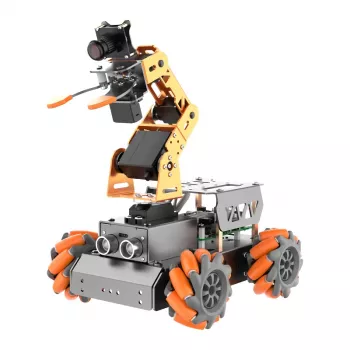
- AI-Enhanced Smart Robot Car with Mecanum Wheels and Robotic Arm
- Elegant Ribbon Bow Pearl Keychain
- Diadora Men’s White Sneakers
FAQ
What are mecanum wheels used for on a robot car?
Mecanum wheels enable omnidirectional movement, including sideways strafing, diagonal travel, and rotation in place. That helps the robot maneuver in tight spaces and align precisely with objects for picking and placement.
Can the robotic arm pick up objects while the car is moving?
It can, but precision and stability improve when the base slows down or pauses during the grip and lift. Smooth acceleration, controlled turns, and keeping the center of gravity low make pickups more reliable.
What kinds of projects can be built with a robot car that has both mecanum wheels and an arm?
Common builds include pick-and-place demos, simple sorting between zones, station-to-station delivery tasks, target alignment routines, obstacle-aware navigation, and hybrid workflows that combine manual driving with automated arm macros.














Leave a comment