4-Week Fit-at-Home Plan: Minimal Equipment, Daily Guide
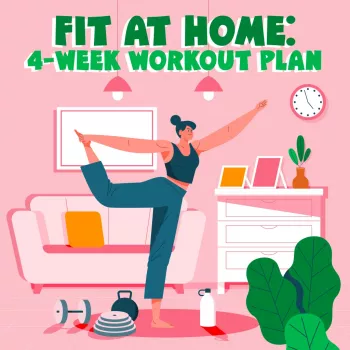
Fit at Home: A 4-Week Minimal-Equipment Workout Plan With Daily Workouts and Stretches
A consistent at-home routine is easier to follow when each day is already planned—workout, warm-up, and stretching included. This 4-week program is built for small spaces, minimal gear, and busy schedules, with clear daily sessions that help build strength, mobility, and conditioning without needing a full gym setup.
What this 4-week plan is designed to do
This program is built around a simple, repeatable rhythm—warm-up → main workout → stretch—so you can show up and start without overthinking. Across four weeks, it aims to build total-body strength using mostly bodyweight (with optional bands or dumbbells), while also improving mobility and recovery through daily stretching. Sessions are designed to fit common home constraints like limited space and limited time, and each workout is easy to scale with beginner-friendly modifications or intermediate progressions.
For a structured, day-by-day checklist you can follow without guessing, the Fit at Home: 4-Week Workout Plan (PDF eBook) lays out daily sessions in sequence—warm-up, workout, and stretching included.
Who it works best for (and how to adapt it)
Beginners can start with the easiest variations (incline push-ups, squat-to-chair), reduce the number of rounds, and take longer rest periods. Intermediate trainees can add a round, shorten rest, slow the lowering phase (tempo), or add light resistance when available.
Busy schedules do well by treating 20–30 minutes as the baseline: complete the warm-up, the main circuit, and a short stretch. If time allows, add a short finisher or a second round. Returning after a break should prioritize clean form, keep 1–2 reps “in reserve,” and progress week to week instead of pushing hard daily. Small-space training is covered by design: movements are mostly stationary (squats, hinges, presses, planks), with low-impact swaps available for any high-impact exercise.
Minimal equipment setup (and smart household substitutes)
You can complete the plan with almost no gear: an exercise mat (or folded towel), water, and a timer/phone stopwatch. If you have them, a resistance band and light-to-moderate dumbbells unlock more pulling and easier progression.
Equipment options for at-home training
| Training need | Minimal option | Optional upgrade |
|---|---|---|
| Lower-body strength | Bodyweight squats/lunges | Dumbbells or loaded backpack |
| Upper-body pushing | Incline push-ups on chair/counter | Dumbbells or band press |
| Upper-body pulling | Band rows (anchored safely) | Heavier band or adjustable dumbbells |
| Core stability | Planks/dead bugs | Slider variations or weighted carries |
| Conditioning | Marching/high knees (low impact) | Jump rope or interval timer |
Smart substitutes work well in a pinch: a backpack with books for loading, towels as sliders on smooth floors, and a sturdy countertop for incline support. Clear a 6×6 ft area, choose a non-slip surface, and keep bands/weights out of walking lanes.
For step-ups, conditioning intervals, and anything involving quick direction changes, supportive footwear can make sessions feel steadier—options like Diadora Men’s White Sneakers help keep things comfortable when training on harder floors.
How the 4 weeks are typically structured
Most weeks follow a balanced flow: strength-focused days to build muscle and joint resilience, conditioning days to improve work capacity, and mobility/recovery emphasis to keep you moving well. Progress usually comes from one of three levers: increasing volume (more sets/rounds), increasing difficulty (harder variations), or increasing density (same work with less rest).
Daily stretching keeps hips, hamstrings, chest/shoulders, and the upper back from tightening up—an underrated advantage when you’re training consistently. A lighter day each week supports recovery; walking and gentle mobility often beat total inactivity for reducing stiffness. If you track just a few notes (rounds, reps, and an effort rating like easy/medium/hard), it becomes obvious when to progress and when to hold steady.
For general benchmarks on weekly activity, see the Physical Activity Guidelines for Americans and the American College of Sports Medicine (ACSM) exercise resources.
Sample day format: warm-up, workout, and stretch
Warm-up (5–7 minutes)
Use a brisk march or step jacks to raise temperature, then add hip hinges, arm circles, ankle/hip mobility, and a few light squats. The goal is to feel warm and coordinated—not exhausted.
Main workout (15–25 minutes)
Run a simple full-body circuit that hits lower body, upper body, and core. Example: squat pattern (squat-to-chair or squat), push (incline or floor push-ups), hinge (good mornings or hip hinge), and core (plank or dead bug). Move steadily, rest briefly, and repeat for rounds based on your level.
Finisher option (3–5 minutes)
Stretch (5–8 minutes)
Making progress without burnout
Staying safe: technique and common trouble spots
Using the PDF eBook day by day
Product details and quick-start
To gear up with simple essentials, start with the Fit at Home: 4-Week Workout Plan (PDF eBook). If you prefer a darker, everyday option for training and walking, Diadora Men’s Black Leather Sneakers are another in-stock pick.
FAQ
How long are the daily workouts in the 4-week plan?
Most sessions land around 20–40 minutes, depending on your rest periods, whether you add an optional finisher, and what equipment you’re using. On busier days, you can stick to one main circuit plus a short stretch and still get a solid workout.
Is this plan suitable for beginners with no equipment?
Yes. Start with beginner variations like incline push-ups and squat-to-chair, do fewer rounds, and rest longer as needed. Focus on smooth reps and steady weekly progress rather than pushing to exhaustion.
What minimal equipment makes the biggest difference if available?
A resistance band is one of the most useful add-ons because it makes pulling movements (like rows) and light resistance work much easier at home. Light dumbbells (or a loaded backpack) also help you progressively overload squats, hinges, and presses as weeks go on.














Leave a comment